

Which PFC Brake Pad Compound Is Right For Your Car?
Find Your PFC Brake Pad Match
Five quick questions about how you drive. The result is a starting point: a front/rear package that matches your workload, ABS behavior, and how you lean on the pedal.
PFC Compound Reference (11 / 40 / 331 / 82 / 81 / 84 / 332)
Prefer to browse manually? Here’s the short version of what each compound is designed to do. The quiz is just a biasing tool to get you into the right neighborhood.
PFC 11 – Sprint / Track-Day Workhorse
High-bite, smooth sprint and track-day compound. Excellent choice for 20–30 minute sessions on ABS-equipped track cars, with strong initial torque and very good modulation.
PFC 40 – High-Bite Sprint Pad
Aggressive sprint material with very sharp initial bite and strong torque. Built for short, hard sessions on slicks and good ABS, where outright lap time matters more than wear.
PFC 331 – Proven Front Endurance Pad
Front endurance compound for GT3/GT4/TCR and serious track-day cars. Higher bite than older 08 material with excellent control, low wear, and clean ABS behavior over long stints.
PFC 82 – New-Generation Front Endurance
Degressive, ABS-optimized front endurance pad with extremely low wear and gentle disc treatment. Developed for modern GT and touring cars.
PFC 81 – Low-Mu Rear Endurance
Low-coefficient rear compound with a very flat torque curve. Designed to keep the rear stable under ABS and deep braking, especially on powerful or aero-sensitive cars.
PFC 84 – Degressive Rear Endurance
High initial bite but heavily degressive rear pad, designed as a partner to PFC 82. Low wear, ABS-friendly, and stable in long-distance racing.
PFC 332 – Smooth Rear Sprint / Track-Day Pad
Rear-focused compound with lower bite, ultra-smooth release, and excellent ABS stability. Very low wear, ideal behind stronger front compounds like 11, 40, 331, or 82.
Factory PFC compound graphs (full overview)
These charts come directly from PFC and show how the full motorsport compound family compares for bite, wear, modulation, and friction versus temperature. Click any image to open it larger in a lightbox and see where each compound sits relative to the others.
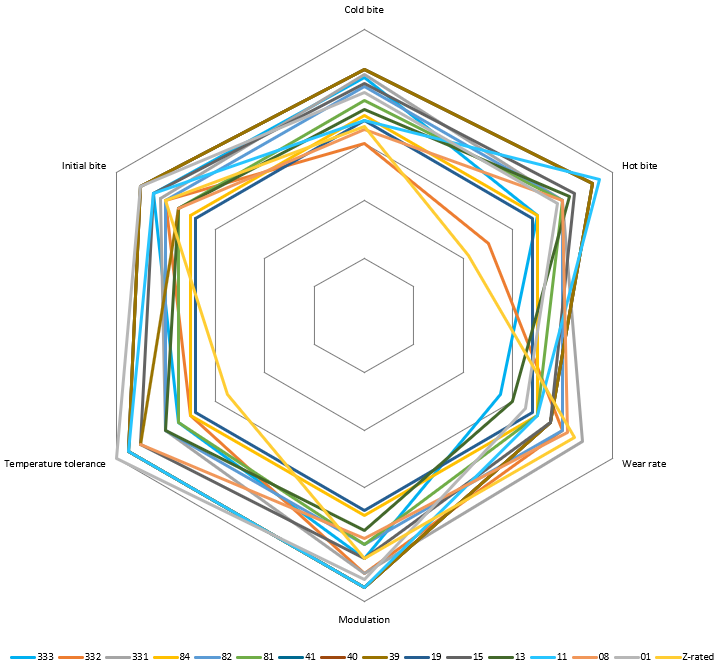
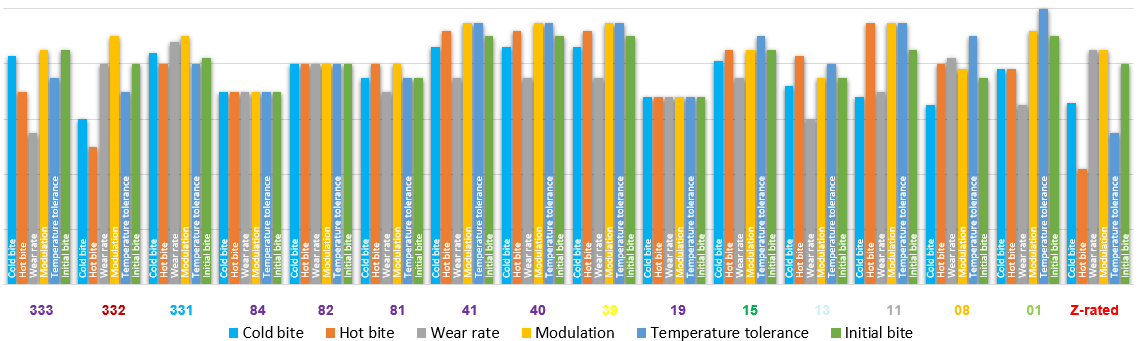
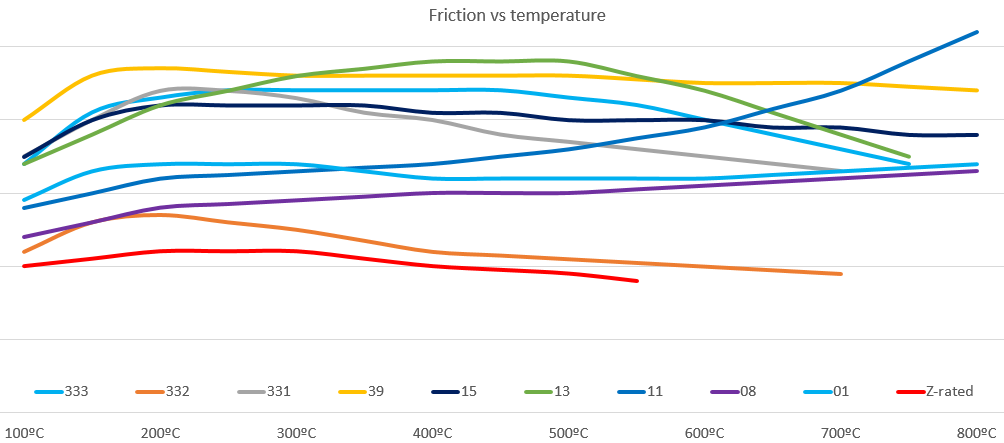

A showdown of our favorite PFC pads: 11 / 331 / 82 / 81 / 84 / 40 / 332
Choosing the “right” performance brake pad for a performance or track car is like picking a tire: there is no best — only best-for-what-you’re-doing.
Performance Friction (PFC) is one of our favorite brake pad manufacturers, thanks to their tried-and-true compounds beloved by track rats everywhere. But, they don’t make your decision any easier by offering multiple motorsport compounds that all look good on paper.
Whether you've got a GT3 that commutes to the office on Fridays plus a few HPDE weekends, a dual-purpose M car, or a dedicated time-attack build, the logic is the same: match the pad to duty cycle, ABS behavior, and how you actually use the middle pedal.
This walkthrough is meant to de-mystify the core PFC compounds we use at Hinz Motorsport:
11, 40, 331, 82, 81, 84, and 332.
If that looks like a jumble of bingo numbers to you right now, fear not. We’ll break down how they behave and what kind of car and driver each one suits.
How to Think About Brake Pad Choice (Before You Obsess Over Compound Numbers)
Before you pick a pad, you should consider your use case, and what characteristics your car is already bringing to the table.
Duty Cycle
How long are you pushing your brakes to their limit?
-
Short sprint / time attack / 20–30 min sessions
-
Long stints / endurance (45–90+ min) with driver changes
-
Mostly street with occasional HPDE / track days
Electronics
What kind of driver assists are you using on the track?
-
Modern ABS & stability control that you keep active
-
ABS on but hacked (coding, motorsport ABS)
-
No ABS / old-school threshold braking
Car & setup
Is your car heavy or light? Set up to dissipate heat?
-
Weight and power (Miata vs GT3-level power/weight)
-
Aero load and tire (200TW vs slicks)
-
Brake cooling quality
Driving style
How do you drive? What do you like to feel when stepping on the pedal?
-
Hard initial hit vs progressive squeeze
-
Heavy trail braking vs “point-and-shoot” (brake hard in a straight line, then off as you turn through the apex)

An Overview of PFC Offerings
PFC’s current product line is split between:
-
Sprint / sprint-endurance pads with higher bite and more “assertive” torque curves
-
Endurance pads tuned around low wear, stable friction, and ABS-friendly degressive curves
The compounds we’re talking about break down like this:
-
Sprint / sprint-endurance front: 11, 40
-
Endurance / long-stint front: 331, 82
-
Rear endurance / stability compounds: 81, 84, 332
We’ll go through them one by one, then talk about sensible front/rear pairings that map to real-world use (street-plus-track, HPDE, sprint, and endurance).

PFC 11 Compound – The Classic Sprint / Track-Day Workhorse
Role: Sprint & medium-distance front (and sometimes rear) pad
Personality: High-bite, smooth, very versatile
PFC 11 is the “new generation” evolution of the old 01 compound. It’s designed for sprint and medium-distance racing, with high initial bite, strong torque, and very little torque rise as temperature climbs. It was specifically tuned to improve modulation and release while keeping the very strong stopping power that made the 01 popular.
Key traits:
-
High bite / high friction without getting sketchy as temps go up
-
Very smooth release, developed to reduce wheel lock at the very end of the stop
-
Good fade resistance and solid disc life for a sprint pad
-
Commonly OE fitment on race cars like Porsche Cup and GT4 platforms
Who should choose 11?
-
You run sprint races or HPDE/track days with 20–30 min sessions.
-
You like brakes with a strong initial hit – something that bites on as soon as you touch the pedal.
-
You want one pad that’s proven across a lot of chassis and doesn’t require a PhD in race engineering to make it work for your setup.
-
You have a performance street car that sees a mix of fast street driving plus proper track time, and you’re willing to swap to dedicated track pads for events.
Where to start shopping for PFC 11
Front pad options: https://hinzmotorsport.com/search?q=PFC+11+Brake+Pads+Front&type=product
Rear pad options: https://hinzmotorsport.com/search?q=PFC+11+Brake+Pads+Rear&type=product
Trade-offs compared to other compounds
-
11 has more bite and torque than the pure endurance compounds like 331/82; it’s great when you want lap time, not 12-hour wear rates.
-
It’s less ABS-optimized than the newer degressive compounds; the new family of compounds (82/84/332/81/331) is better if you’re deeply leveraging ABS for consistency over long runs.
Final note
If you’re coming from a more generic track pad and just want a serious motorsport compound for a dual-purpose street/track car, 11 front with a calmer rear pad (like 332) is a very safe starting point.

PFC 40 Compound – The High-Bite Sprint Hammer
Role: High-bite sprint pad (front on ABS cars)
Personality: Aggressive, sprint-race focused
40 is effectively the modern replacement for 39, positioned as a high-bite, high-torque sprint compound. PFC highlights its use in series like Super GT300, Trans Am, rally, and TCR, where short but brutally intense races are the norm.
Key traits:
-
Very sharp initial bite and strong torque
-
Some friction rise with temperature for the most severe applications
-
Smooth release, and precise control despite the initial sharp bite – essentially a sprint pad that still feels a bit refined.
Who should choose 40?
-
You’re doing short, aggressive sessions: sprint racing, time attack, qualifying runs.
-
You want the pedal to feel immediate and assertive, especially on slicks and with good ABS.
-
You’re not primarily chasing rotor/pad life over a multi-hour race.
-
Your car is properly cooled and track-biased; this is not a pad you’d daily drive on.
Where to start shopping for PFC 40
Front pad options: https://hinzmotorsport.com/search?q=PFC+40+Brake+Pads+Front&type=product
Rear pad options (where applicable): https://hinzmotorsport.com/search?q=PFC+40+Brake+Pads+Rear&type=product
Trade-offs compared to other compounds
-
40 is more sprint-specialized and biased further toward aggressive bite than 11.
-
For mixed sprint + HPDE duty or less aggressive tires, 11 is usually easier to live with.
-
On very long stints or marginal cooling, 331 or 82 will out-last it.
Think of 40 as the compound you run when you’ve already sorted the car, have proper cooling, and you’re now optimizing for outright pace over comfort or longevity.

PFC 331 & 82 – Front Endurance Compounds
Both 331 and 82 are front-axle endurance compounds designed around modern ABS, low wear, and long stints. The newer 82 is effectively the “flagship” front endurance pad; 331 is still extremely relevant and slightly different in character.
PFC 331 – Classic ABS-Friendly Endurance
Role: Front endurance pad for ABS cars (GT3/GT4/TCR/track-day)
Personality: Stable, high-control, low wear
331 is described by PFC as the next generation of their endurance material, developed for front-axle endurance use on ABS-equipped GT3, GT4, touring cars and serious track-day cars.
Key traits:
-
Higher initial bite than 08, which was already a benchmark endurance pad
-
Improved release and exceptional control and feel – very modulation-friendly
-
Low pad and disc wear with very good disc conditioning
-
Designed to work very cleanly with ABS, especially under repeated heavy stops.
Who should choose 331?
-
You’re running endurance races, long HPDE sessions, or coaching days where pads see a lot of hours.
-
You have a heavier or higher-power car with ABS (GT4/GT3, TCR, big-brake BMW/Porsche).
-
You want a calm, consistent pad that doesn’t wander as the stint goes on.
-
You daily a serious car (GT-style, big-brake M car, etc.) and want a front pad that’s happy doing both long track sessions and the occasional back-road drive when it’s properly warmed up.
Where to start shopping for PFC 331
Front pad options: https://hinzmotorsport.com/search?q=PFC+331+Brake+Pads+Front&type=product
Rear pad options (select applications): https://hinzmotorsport.com/search?q=PFC+331+Brake+Pads+Rear&type=product
PFC 82 – New-Generation Front Endurance
Role: New front endurance flagship
Personality: Degressive, ultra-stable, extremely long-wearing
82 is the new standard PFC front endurance compound, and it arrived with a statement: a debut overall win at the 2023 24 Hours of Nürburgring.
PFC describes it as:
-
A degressive pad designed specifically to work with ABS, giving superior control and smooth release and minimizing lockups.
-
Having an extremely low wear rate while being very gentle on discs, making it ideal for long-distance racing.
Compared to 331:
-
82 is more explicitly degressive and ABS-centric, tuned as part of a front/rear package with 84.
-
Wear and rotor friendliness are at least as good, often better, making it very attractive for cost-per-hour.
Who should choose 82?
-
You’re in the endurance sportscar / GT / serious track-day world and want a “set it and forget it” front pad.
-
You rely on ABS heavily and want clean releases into turn-in.
-
You’re running long-run or high-budget programs where pad and rotor life really matter to the spreadsheet.
-
You have a modern GT-style car that’s primarily a track tool but might see limited street mileage between events, and you want the car consistent from session to session.
Where to start shopping for PFC 82
Front pad options: https://hinzmotorsport.com/search?q=PFC+82+Brake+Pads+Front&type=product
Rear pad options (where appropriate): https://hinzmotorsport.com/search?q=PFC+82+Brake+Pads+Rear&type=product
If you’re starting a modern ABS GT or TCR-style build and want a default endurance front pad, 82 is usually the first one to try.

PFC 81, 84 & 332 – Rear Compounds and Brake Balance
Rear pads are not just “the same, but smaller.” The newer PFC family is very deliberately shaped for rear stability with ABS, using lower mu and degressive curves to keep the rear of the car calm while still offering good trail-brake control.
PFC 81 – Low-Mu Rear Endurance
Role: Rear endurance pad with low mu (0.2–0.3)
Personality: Calm, very stable, flat torque
81 is the newest rear endurance compound in the PFC lineup. It’s defined by:
-
Low coefficient of friction (~0.2–0.3)
-
Low initial bite with a very flat torque curve
-
Designed to work with modern ABS to provide a stable, controllable rear end and minimized lockups
-
Low wear, suitable for both long-distance and medium-distance racing
This is the pad you choose when rear stability is non-negotiable – high-power RWD cars, aero cars that are sensitive in trail-braking, or drivers who like to lean heavily on the brake pedal deep into the corner.
Where to start shopping for PFC 81
Front pad options (specific applications): https://hinzmotorsport.com/search?q=PFC+81+Brake+Pads+Front&type=product
Rear pad options: https://hinzmotorsport.com/search?q=PFC+81+Brake+Pads+Rear&type=product
PFC 84 – High-Bite Rear Endurance, Paired with 82
Role: New rear endurance pad, the partner to 82
Personality: High initial bite, heavily degressive, ultra-durable
84 is the new rear endurance compound that, like 82, immediately proved itself with a win at the 2023 24h Nürburgring.
Key traits:
-
Designed as a heavily degressive rear pad to work with modern ABS – stable rear end, minimized lockups.
-
High initial bite yet still very low wear, making it suitable for endurance AND medium-distance work.
-
Like 82, it has extremely low wear and is gentle on discs, with excellent modulation.
Compared to 81:
-
81 is lower mu and flatter – think “stability first.”
-
84 has more initial bite but then falls away (degressive), giving strong support early in the stop but staying ABS-friendly and safe under trail braking.
If you’re building a modern GT or TCR car around 82 front, 84 rear is the intended pairing for many applications.
Where to start shopping for PFC 84
Front pad options (specific uses): https://hinzmotorsport.com/search?q=PFC+84+Brake+Pads+Front&type=product
Rear pad options: https://hinzmotorsport.com/search?q=PFC+84+Brake+Pads+Rear&type=product
PFC 332 – ABS-Friendly Rear for Sprint & Track-Day
Role: Rear sprint / sprint-endurance pad tuned for ABS
Personality: Smooth, lower bite, ultra-smooth release
332 is a rear-only compound that behaves like a “bridge” between sprint and endurance use:
-
Formulated with lower bite and torque for rear applications to keep the rear calm under braking.
-
Smooth release and excellent stability and control, particularly under ABS.
-
Exceptionally low wear rates, making it attractive for rear endurance duty as well.
-
Often described as ultra-smooth and very good for drivers who trail brake into corners, thanks to the progressive release.
332 is often compared to the older 06 compound, which was known for smooth torque and relaxed behavior.
Who should choose 332?
-
You’re running sprint or track-day events and want a rear pad that keeps ABS happy and the car stable.
-
You want to pair a stronger front pad (11 or 40, or even 331/82) with something calmer at the rear.
-
You trail brake and want a smooth, predictable rear as you come off the pedal.
-
You have a dual-purpose street/track car and want a rear pad that doesn’t make the car feel darty as you come off the brakes on real-world roads.
Where to start shopping for PFC 332
Front pad options (limited applications): https://hinzmotorsport.com/search?q=PFC+332+Brake+Pads+Front&type=product
Rear pad options: https://hinzmotorsport.com/search?q=PFC+332+Brake+Pads+Rear&type=product

Putting It Together – Suggested PFC Pad Pairings by Use Case
These are starting points, not rigid rules. Car weight, aero, master cylinder sizing, and driver preference still matter. Of course, if you have any questions at all, don’t hesitate to give us a ring — but if you have any questions at all, don’t hesitate to give us a ring — but if you’re staring at a drop-down list on Hinz Motorsport wondering what to click, this is where we’d begin for common performance/track scenarios.
1. HPDE / Track-Day Car, Modern ABS, 20–30 Min Sessions
(and dual-purpose performance cars that see regular track time)
Goal: Strong, confidence-inspiring braking with reasonable pad life.
Cars: M2/M3/M4, modern 911, GT4, GR Supra, etc.
Baseline package – “HPDE Track-Day Package”
Front: PFC 11
Rear: PFC 332
Why: This is the core HPDE package we build around. 11 gives you high bite and strong torque with good modulation, while 332 keeps the rear calm and ABS-friendly with smooth release and low wear.
Shop PFC 11 front options: https://hinzmotorsport.com/search?q=PFC+11+Brake+Pads+Front&type=product
Shop PFC 332 rear options: https://hinzmotorsport.com/search?q=PFC+332+Brake+Pads+Rear&type=product
If you’re harder on brakes or stacking lots of open-track time into a weekend, a more endurance-biased package that still feels familiar is:
More endurance-biased option – “Long-Stint All-Rounder”
Front: PFC 331
Rear: PFC 332
This shifts the balance slightly toward endurance and long-stint stability while keeping the same calm, low-drama rear behavior.
Shop PFC 331 front options: https://hinzmotorsport.com/search?q=PFC+331+Brake+Pads+Front&type=product
Shop PFC 332 rear options: https://hinzmotorsport.com/search?q=PFC+332+Brake+Pads+Rear&type=product
2. Sprint Racing / Time Attack with Slicks and Good Cooling
Goal: Max attack for short distances, outright lap time priority.
Cars: Club-level GT cars, heavily modified track builds.
Option A – “Sprint / Time Attack Package”
Front: PFC 40
Rear: PFC 332
This is the high-bite sprint package: 40 gives you the assertive, sprint-style front torque, while 332 keeps the rear ABS-friendly and smooth to release, with very low wear.
Shop PFC 40 front options: https://hinzmotorsport.com/search?q=PFC+40+Brake+Pads+Front&type=product
Shop PFC 332 rear options: https://hinzmotorsport.com/search?q=PFC+332+Brake+Pads+Rear&type=product
Option B – “High-Bite, Stable-Rear Package”
Front: PFC 40
Rear: PFC 81
Use this when you want the same big front hit from 40 but need the rear as calm as possible—high aero load, twitchy-feeling chassis, or drivers leaning hard on ABS. 81’s low mu and flat torque curve buy you stability margin at the back.
Shop PFC 40 front options: https://hinzmotorsport.com/search?q=PFC+40+Brake+Pads+Front&type=product
Shop PFC 81 rear options: https://hinzmotorsport.com/search?q=PFC+81+Brake+Pads+Rear&type=product
If you’re on aggressive ABS and absolutely living at the limit every braking zone, you can explore a more endurance-leaning pairing like 40F / 84R to get a degressive rear that supports the car early in the stop but falls away under ABS. That’s more specialized, and generally we start with the options above unless you have a very specific reason.
3. Serious Endurance Racing (GT3/GT4/TCR / Long HPDE Days)
Goal: High, repeatable performance over long stints with minimal pad/rotor consumption.
Cars: GT3/GT4, TCR, endurance-prepped club cars with motorsport ABS.
Default modern pairing – “Endurance GT Package”
Front: PFC 82
Rear: PFC 84
This is the “new-school” endurance combo that showed up with a 24h Nürburgring win right out of the box. 82 front and 84 rear are both degressive, ABS-optimized, and extremely low-wear, designed to be used together on modern GT and touring cars.
Shop PFC 82 front options: https://hinzmotorsport.com/search?q=PFC+82+Brake+Pads+Front&type=product
Shop PFC 84 rear options: https://hinzmotorsport.com/search?q=PFC+84+Brake+Pads+Rear&type=product
Alternative pairing – “Long-Stint All-Rounder”
Front: PFC 331
Rear: PFC 332
This combo is still widely used: 331 provides higher bite than 08 with excellent control and low wear, while 332 keeps the rear torque down, ABS happy, and wear very low.
Shop PFC 331 front options: https://hinzmotorsport.com/search?q=PFC+331+Brake+Pads+Front&type=product
Shop PFC 332 rear options: https://hinzmotorsport.com/search?q=PFC+332+Brake+Pads+Rear&type=product
Use this if:
-
You’re stepping up from 08/06 or older PFC compounds.
-
You want something proven and predictable for long races on known platforms (e.g. Cup/GT4 cars, BMWs, etc.).
4. Rear-Limited, Nervous Cars / Drivers Who Trail Brake Hard
Goal: Keep the rear of the car planted and predictable on entry.
Good options:
Front: 11 or 331 or 82
Rear: 81
81’s low mu and flat torque curve make it excellent at keeping the rear calm, especially with ABS. If you’ve found that rear pads like 332 or 84 still feel a bit too “helpful” when you trail brake, dropping to 81 is a good way to buy yourself some margin.
In practice this is your “Late-Brake Stability Package”: strong, confidence-inspiring front torque paired with a very composed rear so the car stays predictable as you come off the middle pedal—even if the car also has to behave on the street between events.
Shop PFC 11 front options: https://hinzmotorsport.com/search?q=PFC+11+Brake+Pads+Front&type=product
Shop PFC 331 front options: https://hinzmotorsport.com/search?q=PFC+331+Brake+Pads+Front&type=product
Shop PFC 82 front options: https://hinzmotorsport.com/search?q=PFC+82+Brake+Pads+Front&type=product
Shop PFC 81 rear options: https://hinzmotorsport.com/search?q=PFC+81+Brake+Pads+Rear&type=product

Quick Summary – When to Pick Each PFC Compound
11: Sprint / track-day all-rounder. High bite, smooth, good for 20–30 min sessions and club racing. Great default front pad for many modern track and dual-purpose performance cars.
40: High-bite sprint hammer. Best when you’re chasing lap time in short sessions with strong cooling and slicks.
331: Proven front endurance pad. Higher bite than 08, very stable, ABS-friendly, low wear. Ideal for long stints on GT3/GT4/TCR and serious track-day cars.
82: New flagship front endurance compound. Degressive, ABS-tuned, extremely low wear, and gentle on discs. Go-to for modern endurance builds.
81: Low-mu rear endurance pad. Flat torque, very low bite, designed to keep the rear of ABS cars stable and lockup-resistant.
84: High-bite, heavily degressive rear endurance pad, designed as the rear partner to 82. High initial bite, extremely low wear, ABS-optimized.
332: Rear sprint / medium-distance pad with lower bite, ultra-smooth release, ABS-friendly, and very low wear. Great partner for 11, 40, 331, or even 82 on many rear axles.
Pick your compound around duty cycle, ABS behavior, and how brave you are on the middle pedal, then fine-tune with testing. If you’re still torn between two, default to the more endurance-biased option—it’s easier to drive around slightly less bite than around pads that cook themselves halfway through a weekend, whether that’s in a dedicated race car or a serious performance car that you still drive home.
